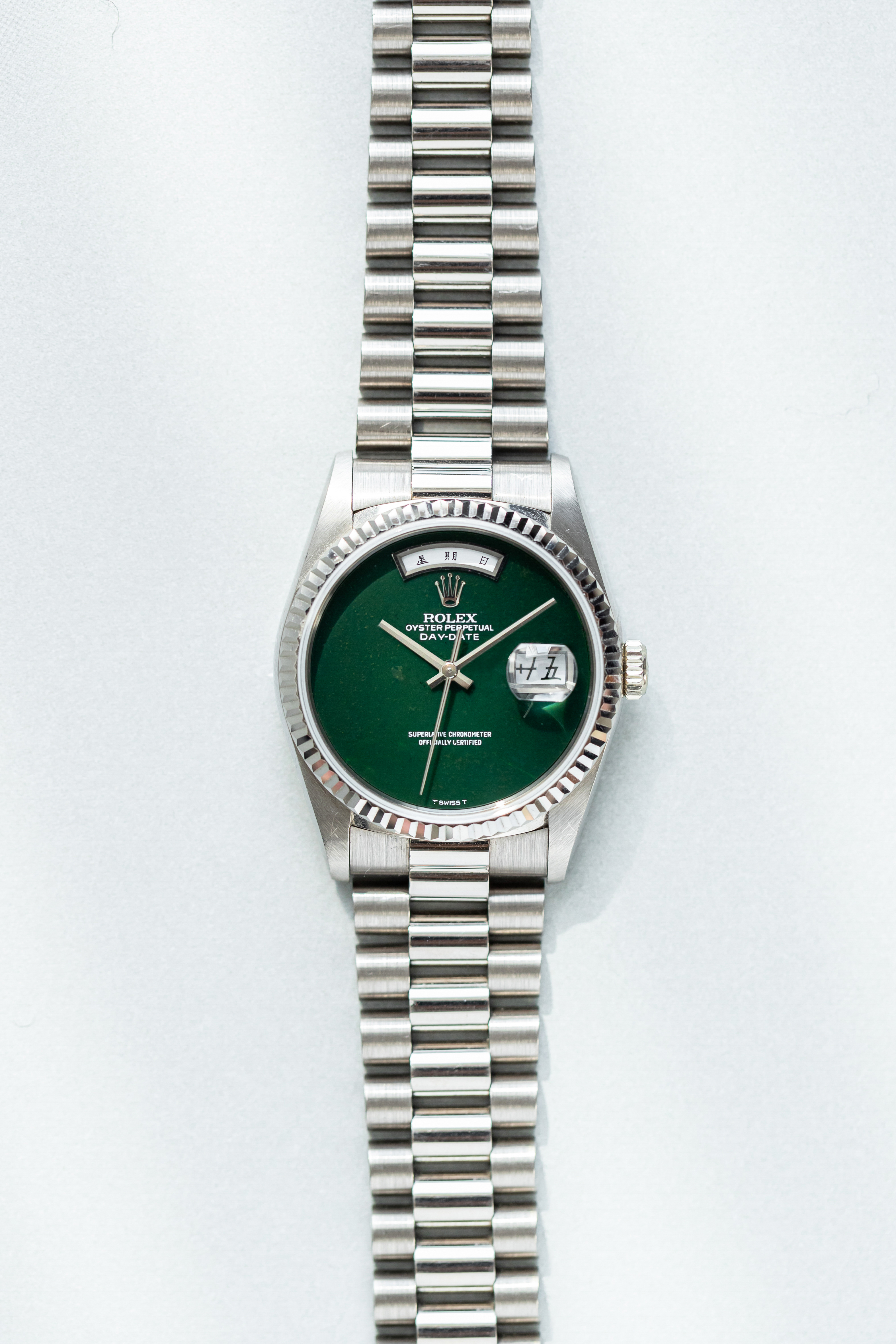
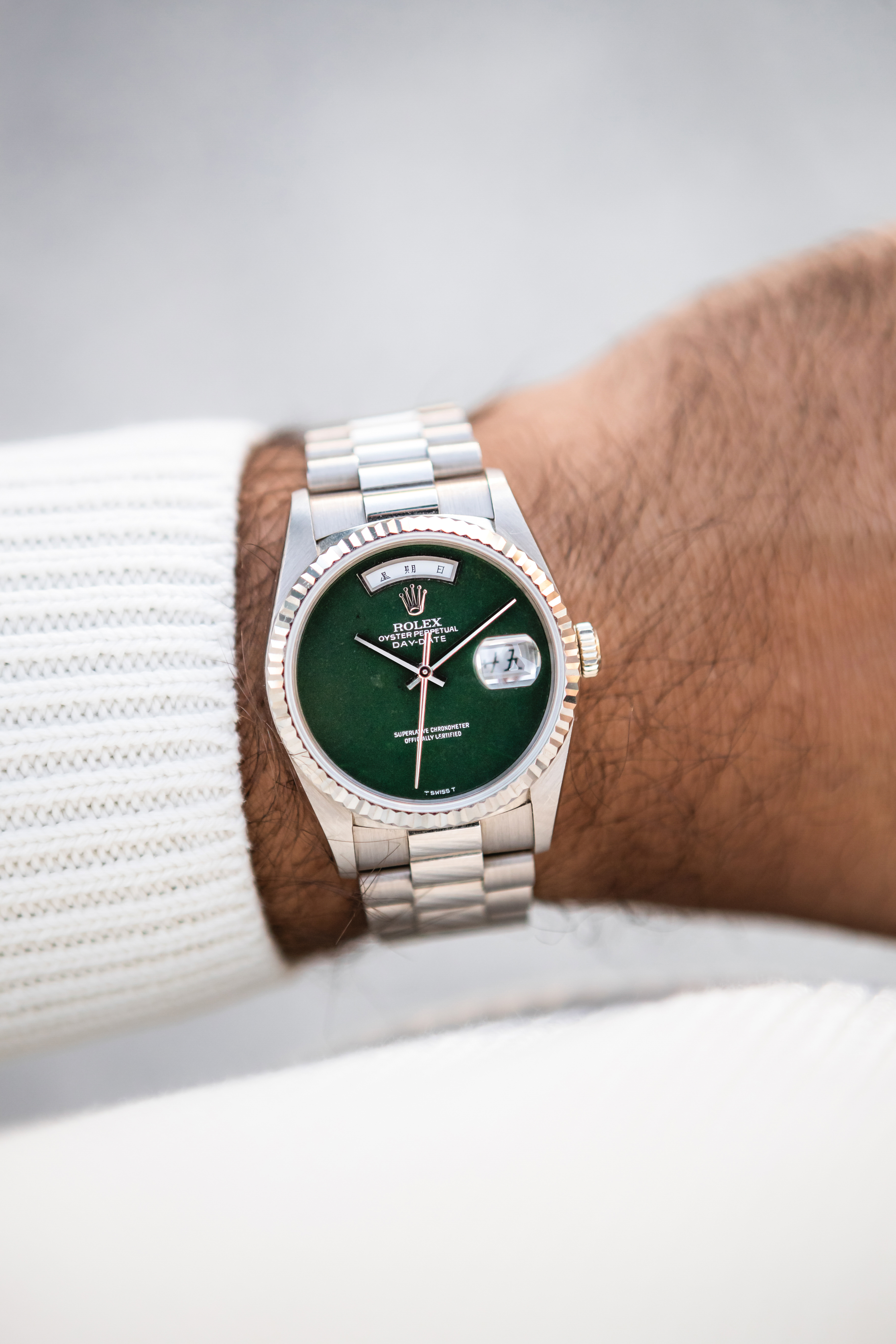
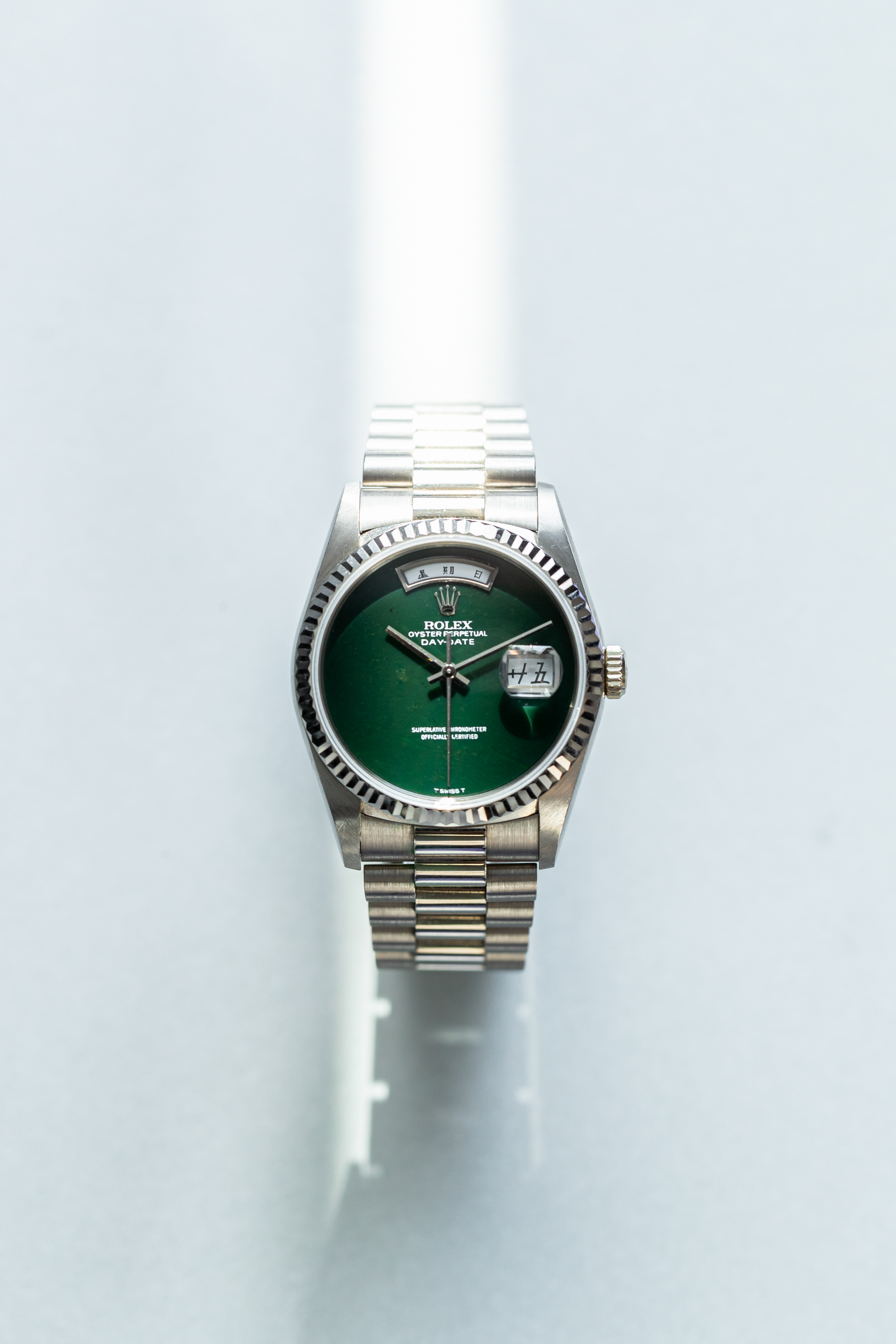
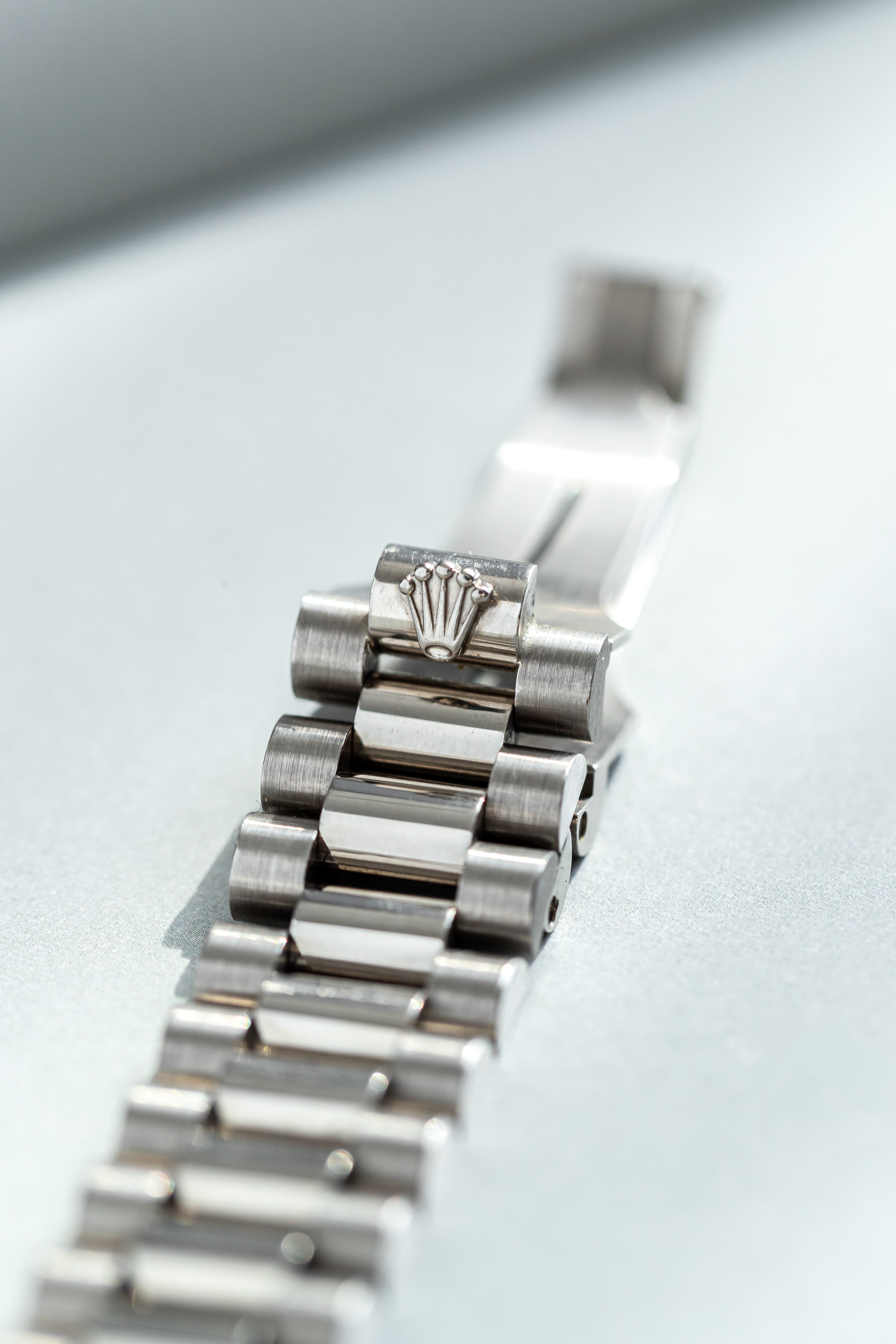
Rolex Day-Date 18239 'Jasper'
If we tell you Rolex made truly unique watches, you might raise an eyebrow. Not because it isn’t true, but because “unique” in the Rolex world is a complicated word and a term that is often loosely thrown around. Sure, this is not a “one-off” piece in the traditional sense. It is not made as a singular commission, nor as an experimental outlier. And yet, in a way that matters far more, each of them is completely unique. Because sometimes, Rolex let nature take the lead.
Enter the World of Stone Dials
About a decade ago, we found ourselves drawn into that world; the world of Rolex stone dials. What started as curiosity slowly turned into fascination, and eventually into something close to obsession.
You can find precious stones on many watches, set into bezels, bracelets, even crowns or hands. But a dial made entirely from stone is something else entirely. It’s where watchmaking meets geology, where time is measured on a surface that took thousands, if not millions, of years to form.
Not every natural material qualifies for this sub-genre. Mother-of-pearl, as beautiful as it is, doesn’t belong to this category. Neither does wood.
When we speak about stone dials, we’re referring to minerals: crystalline materials that are cut into thin slices and carefully mounted onto a metal base. Each slab carries its own pattern, its own structure, its own imperfections. No two are ever the same.
And that individuality comes at a cost.
Craftmanship
These dials are incredibly fragile. Over the years, multiple specialized workshops (around Lausanne, Geneva, Bienne, and Chavornay) were involved in producing them for Rolex. Each faced the same challenge: how to work with a material that could fracture at any moment.
Even something as simple as setting hour markers posed a risk. That’s why many early executions of stone dials were left clean and minimal, not just as an aesthetic choice, but as a practical one. Later on, diamond settings or Roman hour markers were introduced. However, in the collectors’ market, the clean dials are the most preferred.
We are fortunate to handle Day-Dates on a weekly basis. They are, without exception, luxurious and refined watches. But every now and then, one stands apart. One that changes the atmosphere the moment it’s in your hands.
Stone dials have that effect.
The Jasper Dial
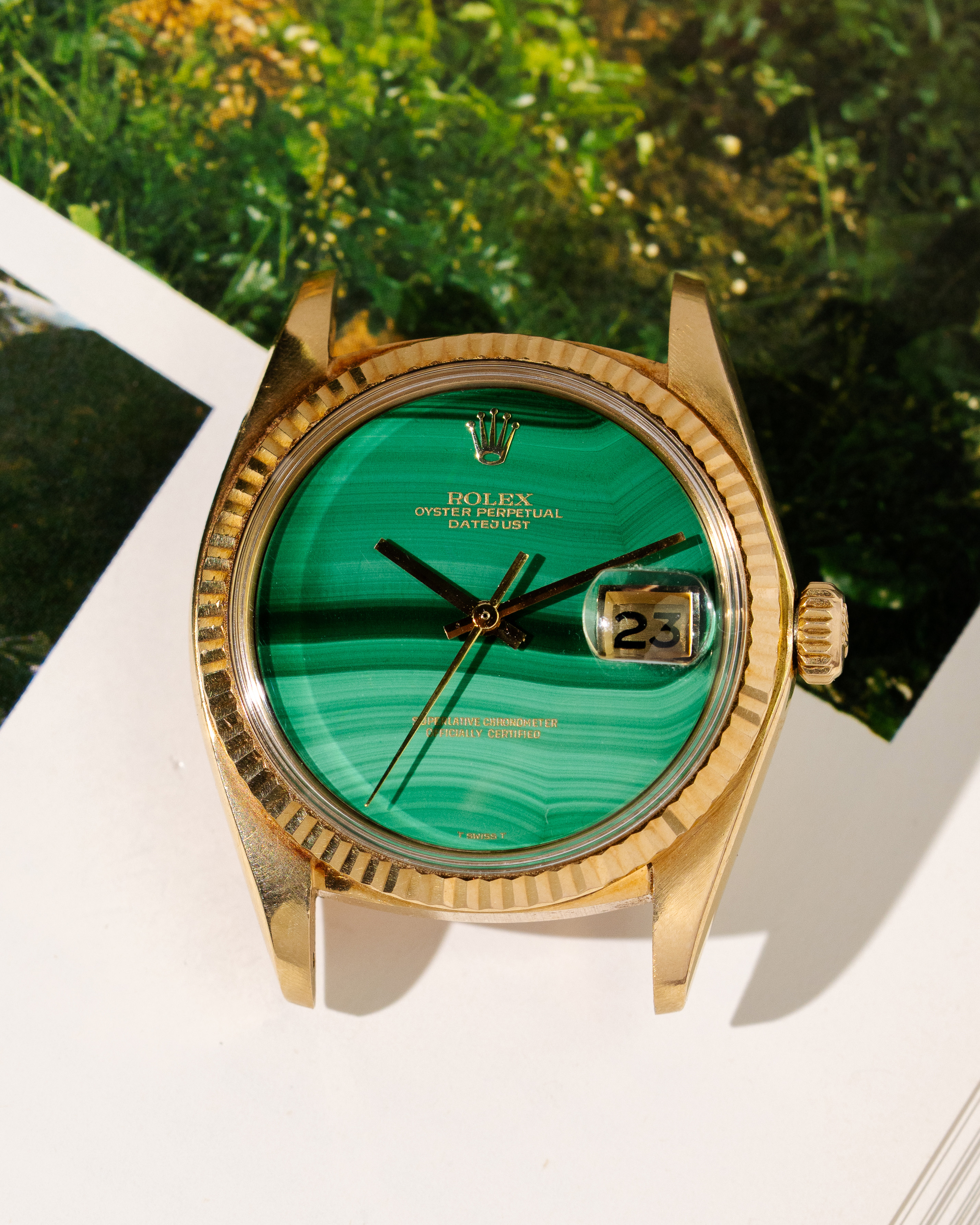
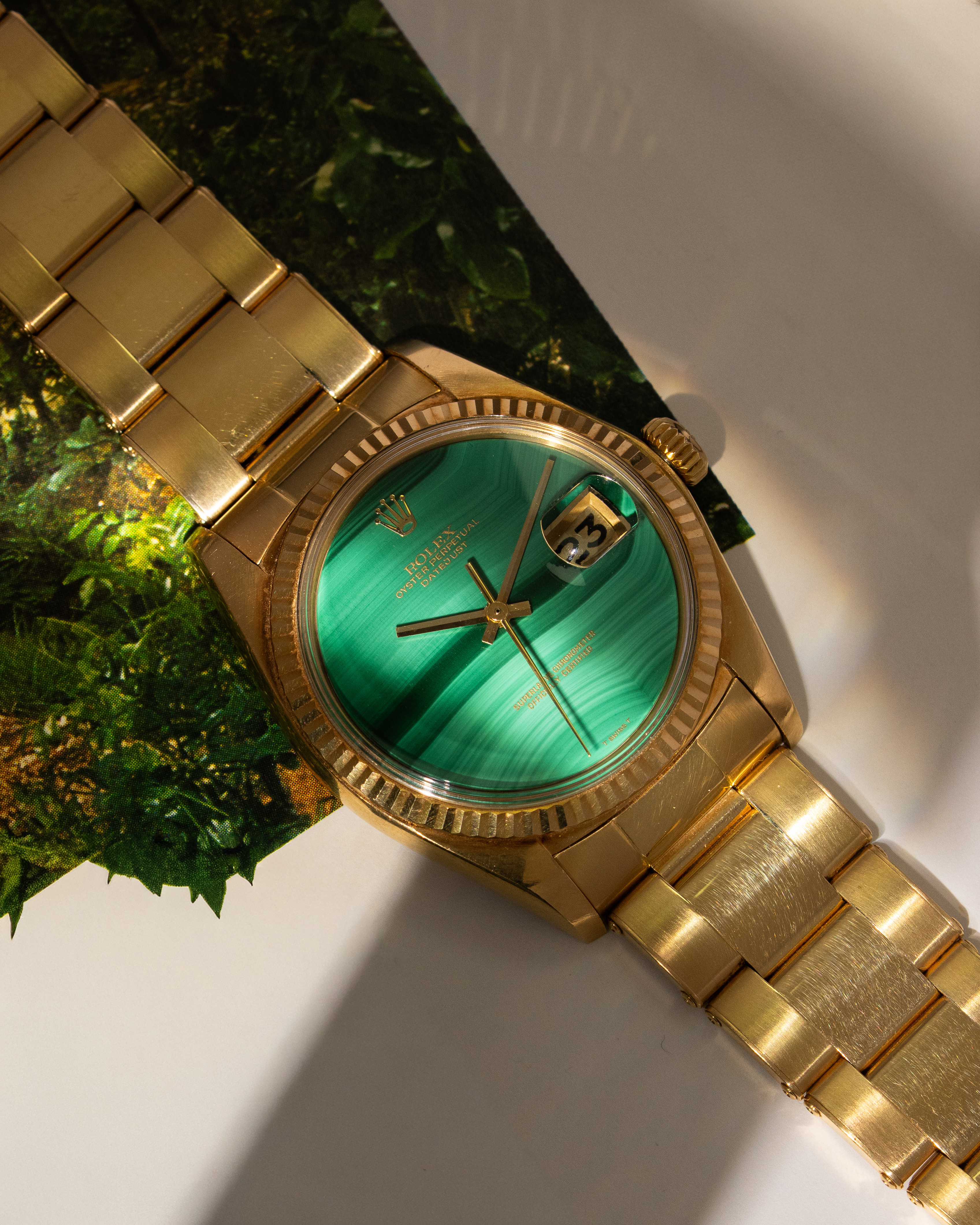
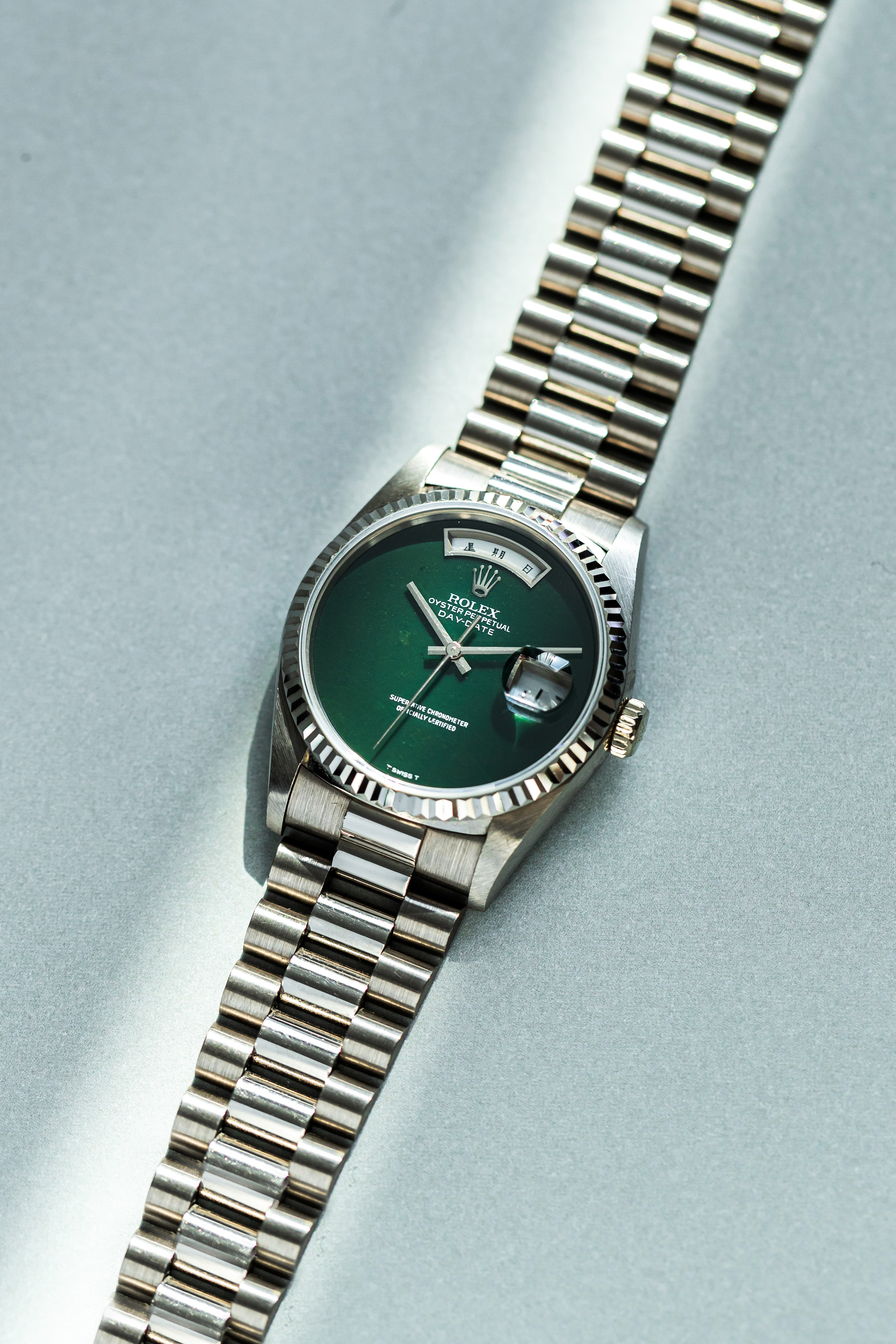
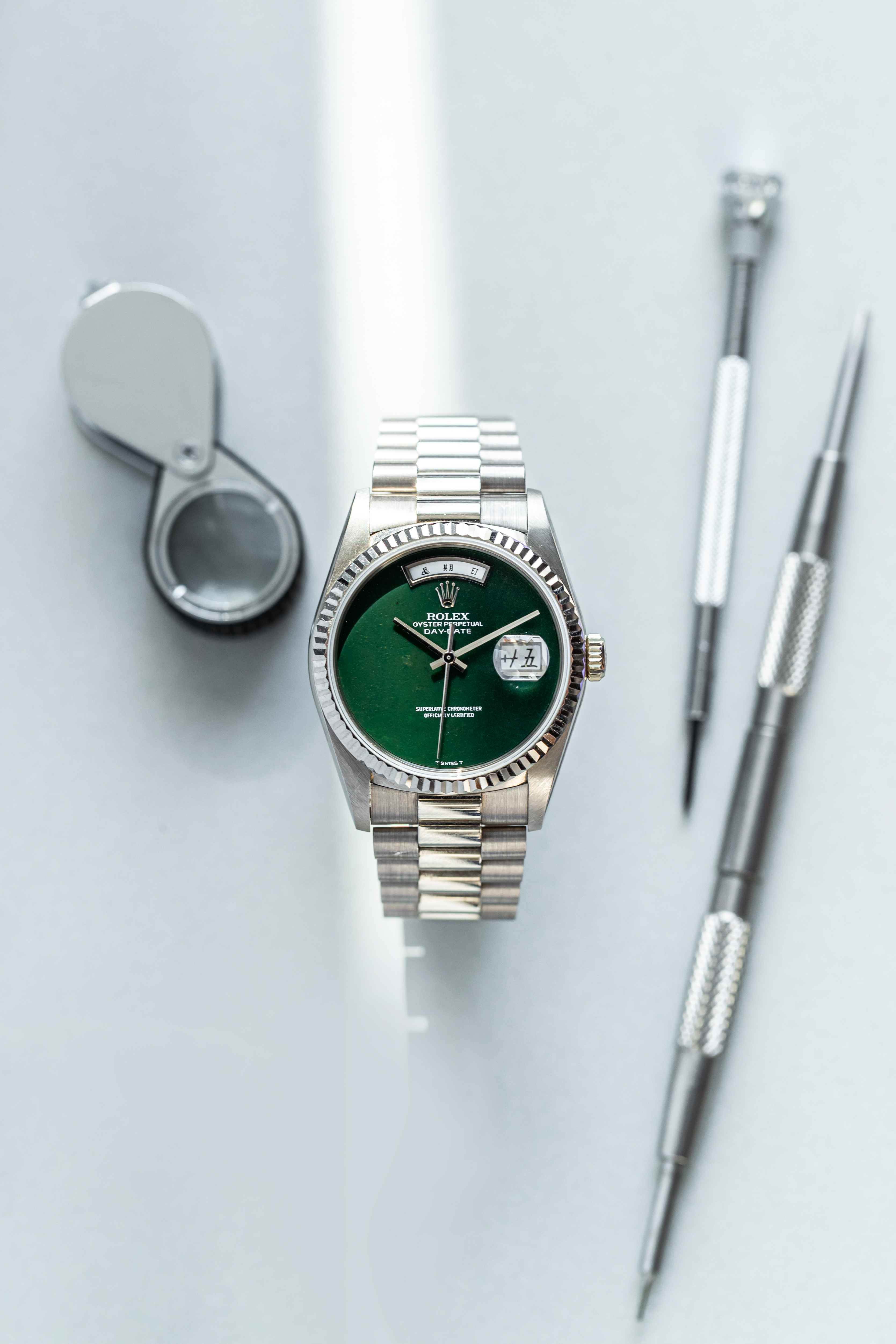
This particular example is one of those moments. A Jasper dial, deep green and almost monochrome. No distractions or interruptions; just a rich, almost hypnotic surface.
The color immediately brings Rolex to mind, yet it feels more organic, more alive. What makes this dial even more special is what it doesn’t have. Jasper often contains red hematite inclusions, in which case it is referred to as Heliotrope or Bloodstone, but here there are none. It’s clean, pure, and remarkably consistent.
We had encountered Jasper dials before, but always in yellow gold. This was our first in white gold. For a long time, we believed finding one in this configuration, let alone in this condition, was nearly impossible. No cracks, no hairlines, nothing.
Only one other example had been documented, published in Pucci Papaleo’s Day-Date book. Since then, a few more have surfaced, but rarity always comes with a caveat: where there is demand, there are also reproductions.
This example dates to a period where forging these stone dials made less financial sense, as it required an arduous and risky production process. However, especially in recent years, these fake dials have become increasingly convincing as market prices have soared. Caution is advised with examples that are unknown to the market.
With a watch like this, the dial is everything. It represents the vast majority of the value, but more importantly, it defines the entire piece. If the dial isn’t right, nothing else can compensate for it. Fortunately, this first-generation example is exactly as it should be. The only minor flaw is some missing print in the left “T” of “T Swiss T”.
As we know, the “T’s” stand for tritium. A common question is raised regarding authenticity, since there is no tritium present on the dial and usually not in the hands either. However, these stone dials used the same cliché to print the text as standard dials. The application of luminous material is the final step in the process. So, just like on regular dials from this period where no lume is present, it still reads “T Swiss T” due to the generic tampography layout.
粵語星期盤
The watch itself has been preserved in beautiful condition since the 1990s. The case remains strong, the bezel sharp, and the overall presence exactly what you would hope for.
It still comes with its original box and papers, showing its origin in Asia. After finding its new owner, Cantonese day discs were installed, a subtle and personal addition that reflects its journey.
Because in the end, that’s what makes these watches so special. Not just their rarity, their materials, or their value, but the fact that each one carries a story. And sometimes, if you’re lucky, you get to be a part of it.
We hope you enjoyed ours. It is one of many.